
 ↗
Hobi ve Kendin YapSiparişe özel
Surprise self opening gift box (no ams)
Nice self opening gift box. Perfect to give for birthdays and Christmas. No AMS needed.
₺350,00
HOTSPOT
Tahmini teslim süresi: 3 gün. Renk seçimini sipariş onayında birlikte netleştiriyoruz.
Bu ürün hakkında soru sorun ↗HOTSPOT A post-fire monitoring and suppression concept for the INFFNI Dobot Rover X1 Pro Flex. Hotspot explores how a four-legged robot could support firefighters after a wildfire has been brought under control. Within an assigned area, the concept patrols difficult terrain, detects remaining heat and responds to smaller hotspots while keeping people out of potentially unsafe areas where possible. Rather than simply adding equipment to the existing Rover, we redesigned the complete exterior around this new role. The result combines thermal detection, targeted spraying, protective misting and emergency signaling in a design language inspired by fire engines, firefighting equipment and rescue tools. We also built a 46.37% scale functional prototype to bring several of these ideas to life. Key Features • Post-fire operation — designed for deployment after firefighters have brought an area under control. • Front + rear thermal sensing — the symmetrical layout allows heat detection in both directions. • Targeted spraying unit — a movable upper sprayer directs water towards detected hotspots. • Shoulder misting — integrated sprayers provide local cooling while moving through hotter areas. • Four-legged mobility — suited to uneven, burnt and obstructed terrain. • Human-supervised autonomy — patrol and small-scale responses happen within an area assigned by an operator. • Fire-service design language — signaling, lighting, graphics and form are intentionally based on firefighting equipment rather than weapon systems. • Complete shell redesign — developed around the existing Rover X1 Pro Flex platform and its internal structure. Functional Prototype Scale: 46.37% Controller: Arduino Nano Prototype electronics: 5 V Upper sprayer movement: 9G servo / ~180° movement Water system: DC pump + silicone tubing Lighting: 5 V RGB LEDs + flexible LED filament Construction: 3D printed shell, mechanical joints, custom attachments and modified off-the-shelf components The prototype demonstrates three of Hotspot's main interactions: shoulder spraying, movement and spraying of the upper unit, and emergency-style signaling. Materials & Components Printing All printed parts were produced using Bambu Lab filament, combining PLA, PETG and TPU: • PLA Silk+ — Titan Gray • PLA Basic — Red • PLA Matte — Charcoal • PLA Basic — Sunflower Yellow • PLA Translucent — Blue • PLA Translucent — Red • PETG Translucent — Clear • PLA Basic — Yellow • TPU 95A HF — Black • PLA Basic — Jade White Prototype Electronics • Micro-controller (Arduino Nano) • 9G servo • 5 V RGB LED strip • Flexible LED filament • DC water pump • 4 mm silicone tubing • Breadboard power supply module Where a suitable Bambu component is available, we have included it as an alternative in the BOM. The links use here a just basic Amazon search links. Below you can find the full story behind Hotspot, the design concept, and how we built the functional prototype. Who we are & how we got here We are Collectief Spoorloos, a group of designers, makers, inventors, engineers, … without a fixed direction, place or destination. This project came our way through one of the people in the collective. We were immediately drawn to it because of our shared connection to MakerWorld and our interest in robotics, making and innovation. The challenge had everything we look for in a project: a deadline, a few “simple” assignments or possibilities, and an idea to run with. The deadline gives us direction; the rest usually develops along the way. What interests us most about new technology is not only how it can make existing tasks faster, easier or more efficient, but especially what new capabilities it can unlock. New technology does not always need to replace something that already exists. Sometimes its value lies in making possible something that was previously difficult, impractical or simply not considered. That became our starting question: where could the INFFNI Dobot Rover X1 Pro Flex do something genuinely new? A four-legged robot can reach places where conventional machines struggle and where people would rather not spend too much time. Fully autonomous primary roles may still be a step too far, but as an assisting system, there are already interesting opportunities today. That quickly led us towards crisis situations: environments where mobility, sensing and an additional physical presence can make a meaningful difference. The story Wildfires, heath fires and other vegetation fires continue to affect regions across the world, and controlling the visible fire is only part of the work. Once the immediate danger has passed, large areas may still need to be checked and cooled for hours or even days. That work is not always carried out by firefighters alone. Depending on the location and scale of the fire, local services, volunteers and residents may also be involved in checking affected areas, sometimes having to walk back through burnt and potentially unstable terrain. A blackened landscape. Wet, earthy and muddy; what was recently trees and vegetation has been reduced to ash. At first glance, the fire appears to be gone. Beneath the surface, however, roots can continue to smolder, peat layers can retain heat and small hotspots can remain active long enough to flare up again. This makes post-fire monitoring and suppression essential, but also repetitive, time-consuming and not without risk. Large areas of uneven terrain need to be checked repeatedly, while the remaining heat is often invisible to the human eye. And importantly, not every part of that process necessarily requires a person to physically walk through the area. That is where the Hotspot concept by Collectief Spoorloos comes in. The concept: Hotspot Hotspot is an autonomous assistant for post-fire monitoring and suppression. Its autonomy starts only once firefighters have brought an area under control and assigned the robot a safe operating zone. Within that boundary, Hotspot can patrol, detect residual heat, respond to smaller hotspots and return for water or charging. It is not intended to enter an active fire independently or make operational decisions in place of firefighters. Sensors integrated at both the front and rear of the robot’s head allow it to inspect its surroundings in either direction. Thermal sensing can reveal heat sources that are difficult or impossible to see directly, such as smoldering roots, underground heat or glowing material beneath a layer of ash. When a hotspot is detected, a movable spraying unit on top of the robot can direct water towards that specific location instead of soaking an entire area. While moving through hotter zones, smaller sprayers integrated around the shoulder joints can also release a fine mist, locally cooling the surroundings and helping protect the robot itself from heat and sparks. One of our main design challenges was making this upper spraying system clearly functional without giving the robot the appearance of a weapon. The visual language therefore draws from fire engines, firefighting tools and emergency equipment, rather than military references. The lighting, signaling, protective frame, graphics and overall body language all reinforce that identity. The four-legged platform is particularly suited to uneven, burnt and obstructed ground. Water is carried inside an integrated reservoir, and when either water or battery runs low, the robot can return to a filling and charging point. Multiple Hotspots could divide a larger approved area between them, while an operator supervises their status, detected heat sources and recent actions from a central interface. The operator therefore remains in control of the wider intervention. Hotspot takes over repetitive patrol and small-scale responses, while unusual, persistent or larger heat sources are flagged for human assessment. To integrate these functions, we completely redesigned the original exterior of the Rover X1 Pro Flex. Its internal frame, motors and core technical platform remain the basis, while the new body creates space for sensing, water storage, misting, signaling and the movable spraying system. The prototype: making Hotspot tangible With limited development time, our goal was not to build a fully functioning firefighting robot, but a functional demonstrator that could make the idea tangible. The prototype was built at 46.37% scale, which naturally influenced what could fit inside the body and how several functions could be implemented. We first reworked the available digital model for physical prototyping, cleaning it up, splitting parts for printing and adding the components needed for our redesign. The printed robot was then assembled using cut parts, nuts and bolts for movable joints, custom attachments and joined sections, resulting in a poseable body. From there, we focused on reproducing a few of the interactions that define the concept. For the shoulder sprayers, we fitted a small water reser Bu ürünün çizimi MakerWorld'den alınmıştır. Yapımcıya teşekkür ederiz. Bu ürün tasarımcının izniyle üretilmektedir.
3D baskının doğal katman izleri ürün yüzeyinde görülebilir. Ekran görüntüleri ile gerçek ürün rengi arasında küçük farklılıklar olabilir.
↗Nice self opening gift box. Perfect to give for birthdays and Christmas. No AMS needed.
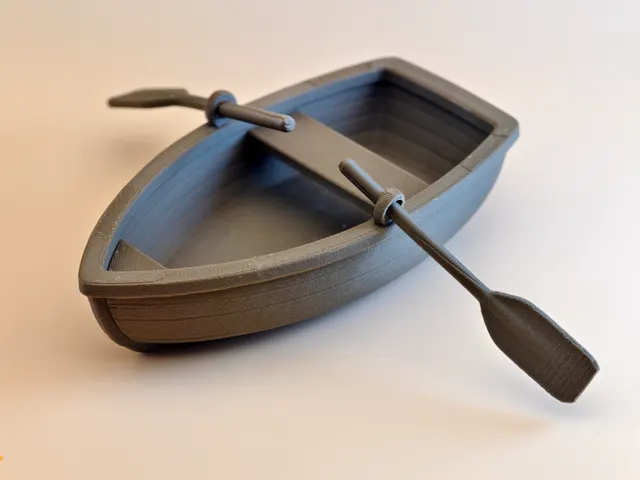 ↗
Bathtub Toy: A double-oared wooden boat that can float on water. Aquarium Decoration.
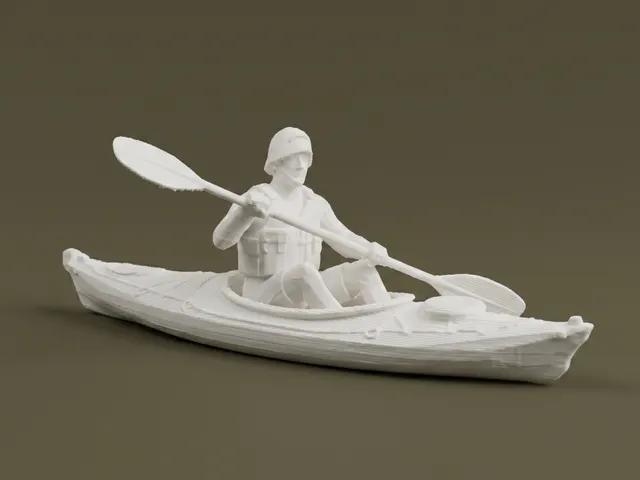 ↗
This detailed figurine shows a kayaker paddling through the water, captured in a dynamic yet clean form. The elongated canoe and realistic pose make it a great piece for outdoor and adventure-themed collections.
 ↗